

Cookie Consent – Switzerland 2026
Guide to nFADP Compliance & Analytics
Most Swiss websites don’t have a cookie problem.
They have a clarity problem.
Cookies didn’t suddenly become illegal. They didn’t disappear either. What changed is the expectation around how transparently and consistently cookie consent is handled in Switzerland, and many website owners are stuck between outdated assumptions and half-implemented fixes.
That uncertainty quietly creates two risks at once:
- cookie compliance issues in Switzerland
- shrinking analytics data.
This guide cuts through the noise. You’ll see what cookie consent in Switzerland really means today, how EU rules can still apply, and how to stay compliant without sacrificing the data your business relies on.

Download the checklist
10 essential checks to secure your cookies, analytics, and GDPR compliance. Visit the checklist page.

Clarity over noise
New to cookies and consent? → Start at the top.
Already familiar with compliance and analytics? → You can jump ahead to the advanced sections below.
Cookies didn’t start as a legal issue at all
Cookies were created to solve a simple problem.
Websites needed a way to remember things like language preferences, login states, or what was added to a cart. Cookies became the lightweight tool that made the web usable instead of forgetful.
Problems only appeared later, when cookies started being used for tracking, analytics, and advertising across tools and platforms. That’s when questions about cookie consent requirements and user choice entered the picture.
The important point is this: cookies themselves aren’t the issue.
How they’re used, and whether users understand and control that use, is what matters today for Swiss websites.

The part of the cookie story most headlines leave out
You’ve probably heard that cookies are “dying.”
That’s only half true.
What’s actually being phased out are third-party cookies, mainly by browsers.
First-party cookies are still very much in use. Analytics, security, and basic website functionality continue to rely on them.
This distinction matters because most discussions around cookie management in Switzerland collapse everything into one idea.
Cookies aren’t disappearing. They’re being treated differently, and that shift puts more pressure on how consent is managed.
Less visibility doesn’t mean less responsibility.
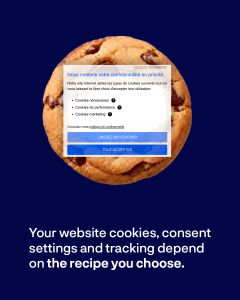
When doing nothing stopped being neutral
For a long time, cookie consent was background noise.
A banner appeared, users clicked something, and everyone moved on.
That changed when regulators, platforms, and users began expecting clear, informed, and meaningful choices.
Cookie consent compliance is no longer just about showing a notice. It’s about whether choices are respected across analytics tools, marketing platforms, and third-party services.
Doing nothing used to be an acceptable default.
Today, it creates uncertainty, and uncertainty is the real risk for Swiss businesses.
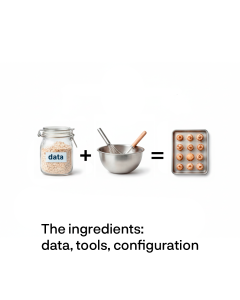
Advanced section, Swiss and EU realities
|
Current Guidance: The nFADP & FDPIC Updates While the nFADP has been the standard since 2023, the Swiss Federal Data Protection and Information Commissioner (FDPIC) frequently releases updated guidelines to clarify how the law applies to new technology. The most recent major update clarifies two critical areas for website owners: High-Risk Profiling: If your tracking goes beyond basic analytics and creates detailed personality or movement profiles (such as combining location data with browsing habits), the FDPIC now views this as a high-risk intrusion. In these cases, a simple “opt-out” is no longer sufficient. You must obtain explicit and granular opt-in consent. Cookie Paywalls (“Pay or Consent”): The guidelines officially address the “Pay or Consent” model. If you ask users to pay a fee to avoid tracking, that fee must be proportionate to the lost ad revenue. If the price is too high, the FDPIC considers the consent “coerced” and therefore invalid. For Swiss businesses, these updates signal a shift. Transparency is no longer just a legal buzzword. It requires a technical setup that respects user choice in real-time. |

Clearing the Air: Swiss Legal Nuances
1. The “Opt-out” Myth (Post-GDPR Reality)
Why the TCA isn’t a loophole.While the Swiss Telecommunications Act (TCA) technically allows for an “opt-out” approach, the FDPIC’s 2025/2026 guidance is now firm: if you use third-party cookies for personalized advertising or cross-site tracking, you have crossed into “intensive intrusion” territory. In this context, the FDPIC expects an explicit opt-in, functionally identical to the GDPR.
If your strategy relies on “tracking until they say no,” you are likely out of alignment with the latest Swiss standards.
2. High-Risk Profiling (The Location Trigger)
Defining “High-Risk”: The Location and Habit Link. One of the biggest changes is the explicit classification of location data combined with browsing habits as high-risk profiling. If your marketing tags track a user’s physical movements (even via IP geolocation) and tie that to their interest profile, you are no longer in “standard” territory.
These triggers a mandatory Data Protection Impact Assessment (DPIA) and requires a robust, granular consent mechanism.
3. The “Cookie Paywall” Guardrails.
The Fair-Price Rule for Cookie Paywalls. “Pay or Consent” models are becoming a popular Swiss alternative, but they aren’t a free pass. The FDPIC requires that the fee be “proportionate.”
💡A pro-tip:
For implementation ensure your monthly subscription fee doesn’t drastically exceed your Average Revenue Per User (ARPU) from advertising.
If you earn 0.50 CHF per user in ads but charge 15 CHF for privacy, regulators may view the choice as “coerced” rather than genuine..
Managing these ‘High-Risk’ toggles manually is a recipe for error. Tools like Biskoui allow you to enforce these rules (like blocking location-based tracking) with a single click.
The Engine Room: Choosing Your Setup
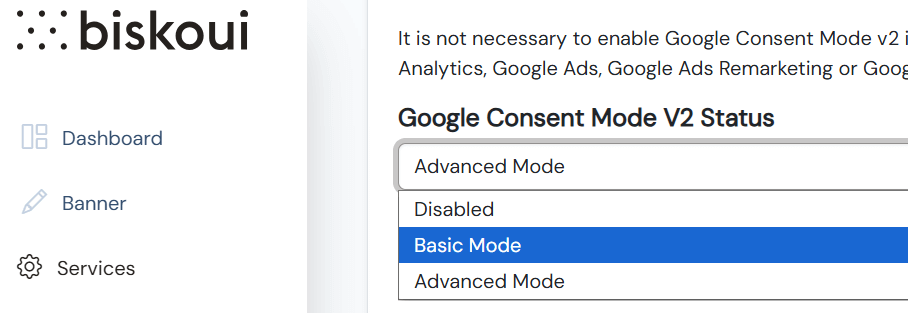
To comply with the nFADP while keeping your marketing data alive, you have to choose how your tracking “engine” behaves. In 2026, there are three distinct levels of technical configuration.
Level 1: Basic Mode (The “Hard Gate”)
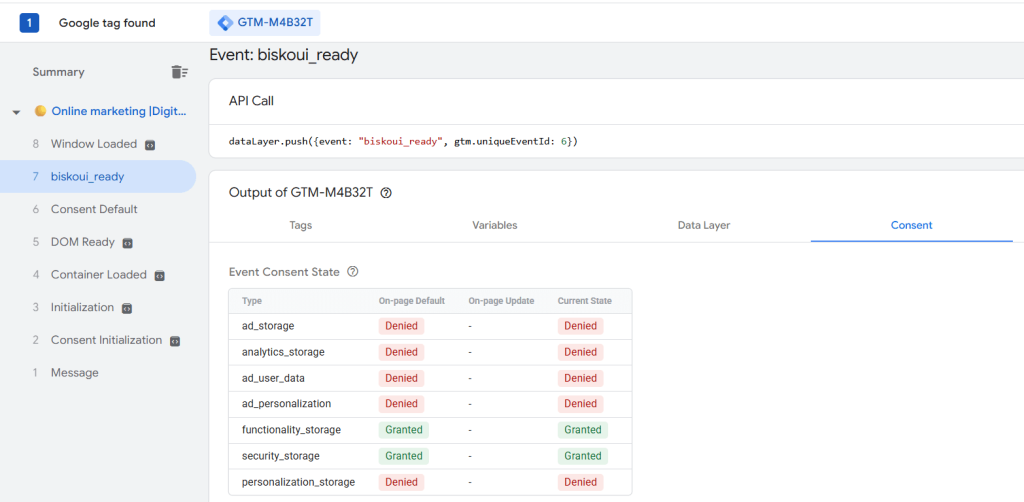
This is the most conservative setup. The tracking tags are physically blocked until the user interacts with your banner.
- How it works: If a user hasn’t clicked “Accept,” the tag simply doesn’t exist on the page.
- Legal Status: 100% safe. No data transfer = No risk.
- Data Impact: High data loss. You miss every conversion from users who don’t interact with your banner.
Level 2: Standard Advanced Mode (The “Pinging” Setup)
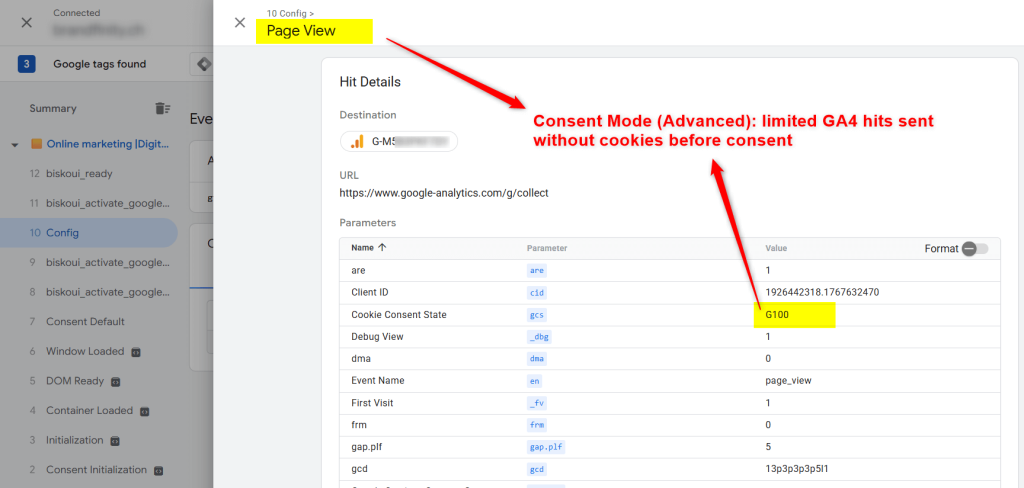
This is the default Advanced Mode you often hear about.
- How it works: The tag loads immediately. Even if the user hasn’t consented, it sends “cookieless pings” (anonymous signals) to Google to help with AI modeling.
- Legal Status: Moderate Risk. Because data (even anonymous) is sent to US servers immediately, the FDPIC may require you to perform a DPIA (see below) to prove you aren’t profiling users without permission.
Level 3: Advanced Mode + “Manage Data Transmission” (The “Smart Queue”)
This is the “pro-level” setup.
It uses Advanced Mode technology but forces it to act like Basic Mode until the user decides.
- How it works: The tag loads immediately but is silenced by a physical block in the code. It records what the user does but queues that data locally in the browser. It sends zero pings to Google.
- The “Magic” Moment: Once the user clicks “Accept” on your Biskoui banner, the queue is released, and all that “missing” landing page data is sent at once.
- Legal Status: Very Low Risk. Since no data transfer happens before consent, you likely avoid the high-risk triggers of the nFADP.

Switzerland is not GDPR but that’s not the full answer
Switzerland does not apply the GDPR by default.
Swiss data protection law focuses on transparency, proportionality, and giving users the ability to object. The emphasis is different from the EU’s strict opt-in model.
However, that’s only the legal starting point.
In practice, many Swiss websites:
- Use analytics or advertising tools from EU or US providers
- Serve or target visitors in the EU
- Want a single, consistent cookie consent solution
In those cases, GDPR cookie consent requirements can still apply, even to Swiss companies. That’s why many implement GDPR-level cookie consent in Switzerland, not because it is always mandatory, but because it is operationally safer and clearer.
Guidance from the Federal Data Protection and Information Commissioner reinforces this direction. Transparency and real user choice matter more than technical loopholes.
The takeaway is simple: legal theory and real-world expectations are not the same thing.
The missing layer between law and technology
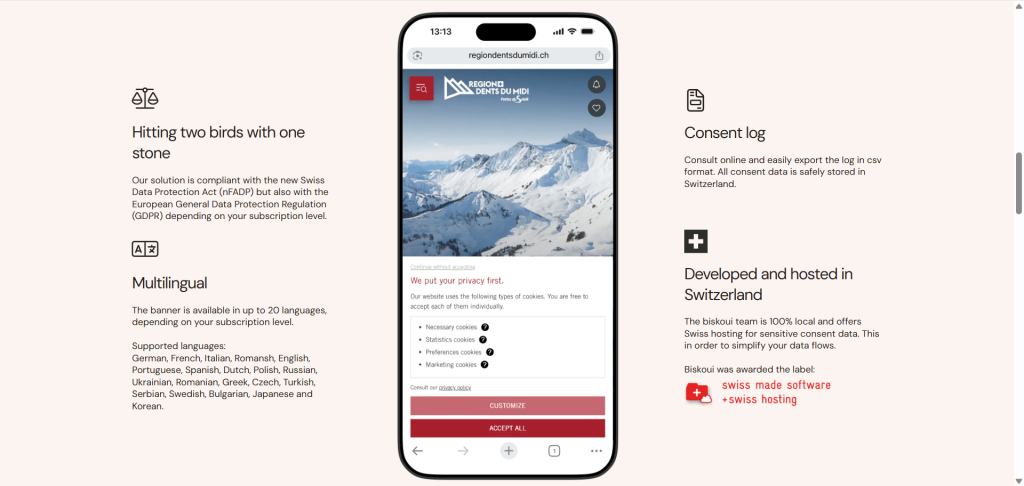
This is where many setups quietly fail.
A banner can inform users, but it doesn’t enforce anything. Once multiple tools are involved, analytics, ads, and embeds, manual consent handling stops scaling.
A consent management platform (CMP) adds the missing structure:
- It centralises consent choices
- It ensures tools behave according to those choices
- It documents decisions consistently
Instead of guessing whether your setup meets cookie compliance in Switzerland, a CMP turns consent into a repeatable system.
For Swiss websites, using a Swiss-made CMP in Switzerland like Biskoui adds another layer of confidence. The platform is designed to align with Swiss legal expectations while remaining practical for real-world implementation

Where compliance and measurement collide
Consent has a direct impact on analytics.
When users decline certain cookies, tools like Google Analytics receive fewer signals. For many teams, this feels like data suddenly going quiet.
This is exactly why Google Consent Mode in Switzerland matters.
With basic consent mode, analytics tools adjust behavior based on user choices and can still provide modeled insights.
Advanced consent mode can enable additional data enrichment when eligibility criteria are met, while still respecting user decisions.
Consent mode does not recover lost data, and it does not guarantee accuracy. What it does is preserve continuity, which is often the difference between usable reporting and guesswork for Swiss marketing teams.
The moment uncertainty drops
The difference between an ad-hoc setup and a structured one is subtle but real.
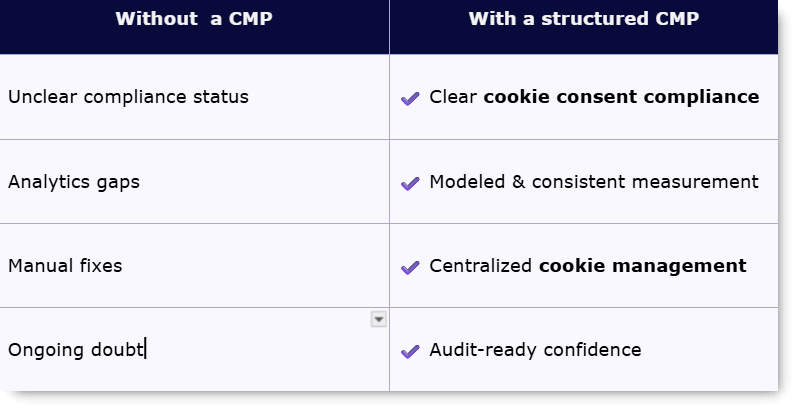
Nothing here is flashy. That’s the point.
The biggest benefit is that things stop breaking quietly.
This sounds harder than it actually is
Implementing a consent management platform in Switzerland is rarely the technical nightmare people expect. Most complexity comes from unclear decisions, not from the tools themselves.
A well-planned CMP setup typically involves:
- Auditing existing cookies and tools
- Defining consent categories
- Configuring analytics and marketing tags accordingly
For teams that want additional certainty, working with a partner like Brandfinity can help ensure the setup is clean, compliant, and future-proof.

The Bottom Line on Swiss Cookies
Cookie consent in Switzerland does not need to be dramatic.
It needs to be clear, consistent, and deliberate.
Cookies are not disappearing. Analytics should suffer less.
And Swiss cookie compliance does not require guesswork.
With the right structure and the right tools, Swiss websites can meet legal expectations without sacrificing all their performance.

| Ready to get your tracking engine running correctly?
Contact Brandfinity for a Technical Configuration and Start your trial today. |
Recent Comments